by Megan | Jun 6, 2026 | AAC, aided language input, aided language stimulation, blog, book recommendations, books, continuing education, core vocabulary, emergent literacy, fringe vocabulary, modeling, Sensory, Sensory extension activities, tips, training
The Dignity of Age-Respectful Materials
Have you ever walked into an upper elementary or secondary special education classroom, and seen teenagers being read baby books because of their perceived “cognitive level?” Do you ever wonder if this is a book they would pick out on their own or if they are just reading it because that’s all that’s available to them?
If these baby books are all that is available to them as readers, we need to reflect on why. If we think that they “can’t” read books or engage with concepts that match their chronological age, are we truly presuming potential and using “the least dangerous assumption?”. It doesn’t seem like it.
Here’s the good news, you do not have to sacrifice rich, age-respectful topics to keep text accessible. Today, we are breaking down how to select and navigate shared reading materials for older AAC users.
High-Interest, Low-Readability (Hi-Lo) Books
“Hi-Lo” books are a great way to introduce or share about more complex and age respectful themes (e.g., sports, mysteries, pop culture, peer relationships, etc) using simplified text that supports their current reading level, whatever that might be.
While there are some publishers out there that specialize in creating “hi-lo” books and text, you can also create them yourself through deconstructing books around preferred topics, repurposing the illustrations and simplifying the text, creating your own or have the reader share what they would like the text to say. These could be physical books or digital books created in Canva, Powerpoint, etc.
Nonfiction, Magazines, and Digital Articles
Don’t forget about all the reading opportunities that are available in non fiction books, magazines and/or articles. These types of texts can also be full of high interest materials, making them not only age-respectful but very engaging.
Some examples of nonfiction texts for older readers include statistics from a recent sports game, recipes (bonus that this includes some math concepts as well), articles about recent video game releases or cheat codes, and so much more!
Modifying Age-Appropriate Texts
Don’t forget, you can read a regular chapter book or grade-level novel to an older AAC user by changing how you interact with the text – no adaptations needed. You can read a paragraph, then summarize the main point using age-appropriate language and modeing on their AAC system, or listen to an audiobook and map out concepts, illustrations, etc on an anchor chart. Pulling in the visual and sensory supports through visual timelines, character maps, etc., can help anchor the learning and plot of the story.
The Golden Rule: Ask the Expert (The Learner)
This is the most important strategy of them all! Providing learners with the autonomy to read what they want automatically increases their engagement and interest in reading, whatever the text might be. Learners need to know that the choice is ultimately theirs. They can choose what they do and don’t want to read.
While we have been discussing ensuring that we are providing “age respectful” materials, we also need to provide “interest respectful” materials, and this can be a very delicate balance. Keep in mind that during independent reading, some learners may want to read a book that may not seem “age appropriate”; however, it features one of their specific interests, and therefore motivates them to read and engage with the text. This is a win!
When engaging in independent reading, “age-appropriate” labels for text are merely a guide, not a hard and fast rule. Many adults still enjoy reading young adult books, even though they may not appear “age-appropriate” on the surface. Everyone is entitled to read whatever is of interest to them and gets them excited about reading. True autonomy in reading means having the right to choose what you love without judgment.
by Megan | May 25, 2026 | AAC, aided language input, aided language stimulation, blog, book recommendations, books, continuing education, core vocabulary, emergent literacy, fringe vocabulary, modeling, Sensory, Sensory extension activities, tips, training
The “Story Time” Box
When I say “story time,” what comes to mind? Do you picture a teacher or librarian reading to learners who are sitting on a rug? Or maybe you think of bedtime, reading them a story before tucking them into bed. While these are both wonderful ways to picture “story time”, they aren’t and shouldn’t be the only images we think of. Shared reading or “story time” can happen anywhere and at any time.
Here’s the biggest reason we need to widen our literacy lens to include shared reading into our whole day. If we only open books during these specific, rigid windows, we limit our AAC users’ exposure to literacy and miss out on high-engagement moments throughout the rest of the day. The good news is that shared reading doesn’t require a designated “literacy block.” Today, we’re breaking down how to effortlessly weave literacy into the natural spaces of your entire day without adding more tasks to your to-do list.
Literacy in Transition Zones
While transitions might not be the first place you think of when looking for areas to add more literacy into your day, they are actually a perfect time.
- Why: Transitions (waiting for the bus, sitting in a waiting room, moving between activities) are often high-anxiety or high-boredom zones. Books provide a grounding focal point and a way to keep minds and hands busy.
- Actionable Ideas:
- Keep a “car book basket” for regular commutes or a book cart in transition areas of the home or classroom so learners can grab a book to read while they wait.
- Use short, high-interest digital books on a phone or tablet while waiting in lines, or bring a book bag filled with quick reads that you can easily share if the waiting is longer than expected.
- AAC Modeling focus: Go, Wait, Stop, Open, Look.
Environmental Print & Functional Reading
- Why: Literacy isn’t just found in the pages of a book. It’s all around us. Pointing out letters and words in the environment allows learners the opportunity to interact with them in multiple environments.
- Actionable Ideas:
- In the Kitchen: Read the steps of a recipe together while making a snack, or point out logos on cereal boxes, juice cartons, etc.
- Out and About: Point out stop signs, grocery store aisle markers, or giant billboards.
- AAC Modeling focus: Eat, Make, Big, See, Stop.
Play-Based Reading (Bringing Books to the Toys)
- Why: Meeting the learner where they are already regulated and happy. By bringing the book to them, you take away the frustration that might come from moving away from a preferred activity to reading. By bringing a book directly to their preferred toys, you are utilizing the sensory anchors we discussed in week 5 to pair high-interest concepts with natural language.
- Actionable Ideas:
- Bringing a book about construction vehicles directly into the sandbox or rug where they are playing with toy trucks.
- Read one page that matches what the toys are doing, giving language to their play that matches the book.
- AAC Modeling focus: Words like Up, Down, Crash, More, Like.
The “Routine Planner” Reminder
In week six of this shared reading series we talked about shared reading at home and shared a “home routine planner” highlighting a variety of ways that you can add books into specific routines to integrate literacy throughout the day. While you may be able to incorporate some of these into your classroom or therapy session, others may be only for routines at home.
However, using this mindset that you can incorporate literacy into all parts of your day, think about the different routines and activities that are staples in your classroom or therapy sessions. What books could you incorporate into that routine? Could you add in an extension activity to further the learning even more? This repetition with variety freebie may help you get your creative juices flowing.
Building beyond story time
If you’re feeling motivated and ready to start embedding literacy throughout the day but feel like you could still use some more guidance, my my e-book, Shared Reading with AAC users, gives tangible examples and ideas on starting and implementing shared reading throughout your day. And, because embedding literacy throughout the day is much easier when you don’t have to spend hours prepping the materials, I’ve got some ready to go sensory based literacy kits available in my shop that will make planning and prepping a breeze.
Before you go, share in the comments: What is one routine in your day where you could easily slip in a 2-minute story?
by Megan | May 11, 2026 | AAC, aided language input, aided language stimulation, blog, book recommendations, books, continuing education, core vocabulary, emergent literacy, fringe vocabulary, modeling, Sensory, Sensory extension activities, tips, training
We Finished the Book… Now What?
Stop!
Don’t put the book away yet!
You have finished your shared reading activity, but that is just the beginning! The connection that is created during shared reading can be used as a springboard for follow-up activities that turn a single story into a week-long learning experience.
Follow-up activities help deepen the connections between the reader and the story while promoting generalization of core vocabulary and bringing other themes, concepts, etc., to life. In this post, we will discuss five simple, no-prep activities that focus on engagement over “work” and show you how the learning doesn’t “stop” once the book is finished.
Activity 1: Predictable Chart Writing
Predictable chart writing is a collaborative writing activity where each learner completes the same sentence frame based on a concept or idea from the book that was read during shared reading (e.g., “On Monday, I ate _____”). The repetitiveness of this structure allows for consistent and repeated modeling of core and fringe vocabulary, lets the learner see their spoken words turned into text, and provides practice for emergent writing.
The full concept of predictable chart writing includes additional steps and teaching strategies focused on building print knowledge and sentence-building skills, etc., and you can dive even deeper into it here: https://project-core.com/professional-development-modules/.
While there are multiple steps to completing the full predictable chart writing process, you can start simple, writing your sentence frame on a whiteboard, poster paper, construction paper, or even a digital tablet. The focus should be on deepening the connection between the reader and the story and building their literacy skills through emergent writing and expression.
Activity 2: The “Story Retell” Sensory Bin
In the post “How Sensory Supports Can Make Shared Reading More Accessible and Engaging,” we talked about creating “literacy kits” or “story bins” to keep learners engaged during shared reading and build connections between the learner and the story. Providing learners access to these story bins after shared reading, during a center or open-ended play time, is a great way to encourage them to retell the story in their own way and deepen their connections to the story.
While observing their open-ended play and interactions with these literacy kits, we have additional opportunities to model core and fringe vocabulary that matches what they are doing in play, as well as reference back to the story and what they might be retelling through their play. If you need some reminders on what to model during these activities, this post might be helpful.
Activity 3: Text-to-Self Connections (The Photo Hunt)
Building connections between the text within a story and the lives of readers is a very powerful way to help readers engage with stories and see that the things they read about are all around them. One fun way to do this is to go on a photo scavenger hunt, looking for things that they read about in the story.
For example, if they read about a “big” dog, go on a scavenger hunt for other “big” things, and snap a picture of one when you find it. This brings what could be abstract concepts back to concrete thinking and shows how these concepts appear within the readers’ real lives. A bonus activity could be compiling all the pictures into a book to add to their bookshelves to revisit at a later date.
Activity 4: Digital “Book Trailers” or Recaps
One of my favorite things about being a reader is telling other people about my favorite books and why they should read them. Why not give that same experience to your learners?
There are many ways that you can do this using apps such as Pictello, Canva, Google Slides, or just your camera roll, taking pictures of the learners’ favorite parts of the book and pairing those pictures with the learner sharing about that part of the book in their own words.
This activity builds narrative skills and gives the learners a “product” they can show off to others through their AAC device. (Bonus points if you embed the video into a button on their device for them to show others!)
Activity 5: Character “Check-ins”
Social-emotional learning and teaching descriptive vocabulary lend themselves to acting and experiencing. Often, characters are described by what they look like, what they are doing, or what they are feeling. While illustrations can sometimes show these descriptions and emotions clearly, other times they are more difficult to determine from illustrations alone.
This is where the character “check-ins” can be really helpful, not to mention fun! Learners can act out the emotions that the character is feeling. If the character is “mad”, everyone can make their “mad” face and find “mad” on their AAC system. If they are being “silly”, everyone can show what they think “silly” looks like and find that word on their AAC system as well.
Not only does acting these things out help deepen the connection between the characters and the readers, but it also teaches them how to locate and use these important words in calm and engaging environments so that they will learn to use them in environments when they are feeling “mad” or “silly” themselves.
Which one will you try first?
After reading through these different ideas, I hope that you see how much more learning and fun can be done once you reach the last page of the story. Remember that shared reading is just the beginning of the lesson, and the connection that you create during that routine can be deepened and continued long after you close the book.
If you are looking for some “ready-to-go” literacy kits with interactive extension activities prepped and ready to go without any extra work on your end, check out my sensory-based literacy kits available as full kits with the book included, kits with just the materials, and digital downloads.
Before you go, share in the comments which activity you are excited to try first with your learner(s) as a way to extend and deepen your connection to the story!
by Megan | Apr 20, 2026 | AAC, aided language input, aided language stimulation, blog, book recommendations, books, continuing education, core vocabulary, emergent literacy, fringe vocabulary, modeling, Sensory, Sensory extension activities, tips, training
When “Just Reading” Isn’t Enough
You picked the book, prepped the materials and set up the environment and feel ready to start shared reading with your AAC user. But, when you get started, the learner keeps moving around, wants to stay on the same page, flip through pages quickly and closes the book again and again.
Before you take this as a sign that the learner is “checked out”, not interested or that you need to revamp your entire lesson, take a moment to reflect and think about why they are doing those things. I can guarantee you that they are not doing those things to make the shared reading experience more difficult. They are showing you what they need in order to keep their body calm and regulated and allow themselves to focus on the AAC device and/or story.
When we provide sensory supports for the learner during the shared reading experience, we not only help learners stay calm and regulated, we provide anchors that keep them present in the experience.
Proprioceptive & Vestibular Input (Moving while Reading)
For some learners, movement is a prerequisite for attention—they literally need to move their bodies to process what they hear. If your learner struggles to sit still, try these shifts:
- Adaptive Seating: Offer a bean bag, wiggle cushion, stool, or even a swing during storytime.
- Action Modeling: Incorporate movement into the story itself (e.g., “The bear is jumping! Let’s jump!”).
- Change of Scenery: Move to different parts of the room for different chapters or pages.
Remember: Just because a learner is moving doesn’t mean they aren’t listening. For many, the movement is exactly what allows them to stay tuned in.
Tactile Anchors (The “Touch-and-Feel” Beyond the Book)
Other learners may need or prefer additional tactile stimulation to get and keep them engaged during shared reading. Giving hands something to do often gives the brain more space to focus on language. Here are some ideas to increased tactile input during shared reading:
- Story Bins: Create “literacy kits” with items representing the story, like soft fur for a bear or a small cup for tea time.
- Themed Fidgets: Provide fidgets that match the book’s theme to keep the learner’s tactile system engaged with the topic.
Sensory Minimalism: Reducing the Noise
While we are thinking about the different things we might need to add to help make shared reading more sensory friendly, there are also some things we might need to decrease. While some learners might seek out visual and auditory input, too much of this type of input can also be overwhelming for some. Knowing our learners and their sensory preferences, allows us to reduce the “sensory noise” so that the AAC voice and the book can be the stars. Here are some actionable ideas you can use to help decrease the auditory and visual distractions:
- Lighting: Use a reading lamp instead of harsh overhead lights.
- Auditory: Minimizing background noise
- Visual: Using a dedicated “reading rug” to define the space.
The “Low-Tech” Sensory Kit
Before you start thinking that you need to go out and buy a bunch of new things to revamp your room, area, etc. take a look around your home or classroom, you probably have a lot of items you can use to support sensory needs during shared reading.
-
- Comfort: Pillows, blankets, cushions
- Movement: rocking chairs, wiggle seats, trampoline, swing
- Tactile: Various textures and/or items that the learner can feel and interact with while reading – bonus if they are related to items within the story.
- Tactile: Preferred fidget items
- Movement: Different areas that you can move to throughout the reading if needed or a specific place that is your “reading area’.
- Lighting: dimmable lights or light from lamps instead of overhead lights
- Auditory: quiet space, headphones
The possibilities are endless!
Once you get started seeing things from a “sensory lens” you will come up with many more ideas that are personalized to your learner than I can list here. You are the expert on your learner. These tools simply help their environment match their needs.
If you are interested in learning even more about sensory supports and how they can make shared reading accessible and engaging and want to see some examples of sensory based literacy kits you can check them out in my store.
Before you go
Share with us in the comments: “What is your learner’s favorite sensory support during storytime?”
by Megan | Feb 3, 2024 | blog, books, emergent literacy, Sensory extension activities, tips
Sometimes, when you are stuck thinking of something you can do in therapy, to highlight literacy, or simply in play, you may think you have to come up with something new but read on to find out why you don’t and why repeating the same things can be beneficial for all learners.
Repeating things we’ve done before and maybe making them a little different is called “repetition with variety” and it’s a very important, research-backed technique that helps learners of all ages learn, understand, and retain new information, concepts, etc. A really simple way to think about it is: that repetition with variety is doing the same thing while also making it different. Sound confusing? Let me explain…
My favorite way to explain and use repetition with variety is with a book. It’s as simple as:
📚 read an engaging book
📚 engage in an extension activity related to the book
and then in the next session:
📚re-read the book
📚engage in a different extension activity related to the book
Here’s another example:
- Read “If You Give a Mouse a Cookie”
- After reading, learners can share their favorite type of cookie through a predictable chart with the stem: “My favorite cookie is _____.”
- Next session you re-read the book.
- After re-reading, learners can review the chart and then graph the different types of cookies to see which one is most liked.
- Additional extension activities could be:
- Sequencing the story
- Tasting cookies
- Making cookies
- Creating your own “if/then” scenarios to add to the book or write your own
- So many more!
As you can see, you can repeat the cycle – using repetition with variety – as many times as you want. Through repeating the reading of the book you are helping build literacy confidence in the learners and I promise they aren’t bored reading the same book. In fact, as readers become more familiar with the text through the repeated readings they may start to join in on reading the story with you!
Any questions about repetition with variety? Drop them in the comments on this post.
Until next time – happy reading!
~ Megan
by Megan | Feb 10, 2021 | AAC, aided language stimulation, core vocabulary, modeling, Sensory, Sensory extension activities, Storybook Sessions
Storybook Sessions: Garrett Morgan
In each Storybook Sessions post, I highlight a book that I have used, or plan to use in therapy as well as associated, extension activities that can be paired with the book to increase vocabulary comprehension, provide opportunities to express yourself verbally, written, creatively, etc., sensory exploration, fine motor practice, gross motor movements, etc. Some extension activities will focus on all of these components while others will focus more specifically on one area.
Garrett Morgan
Author: Megan Stewart
Illustrator: Symbols by Boardmaker 7
Do you ever have an idea for an activity to do, book to read, etc but can’t find exactly what you are looking for? Anyone else, or is it just me?
This happened to me while I was planning for my February sessions. I knew I wanted to highlight a famous black person from history to celebrate Black History Month with my students but while looking for a book to lead my activity/session, I wasn’t able to find what I was looking for. I will say that there are a TON of great kids books featuring and highlighting famous black people, however I waited too long to put these on hold or check out from my library, so I decided to create my own.
My Book Creation Process
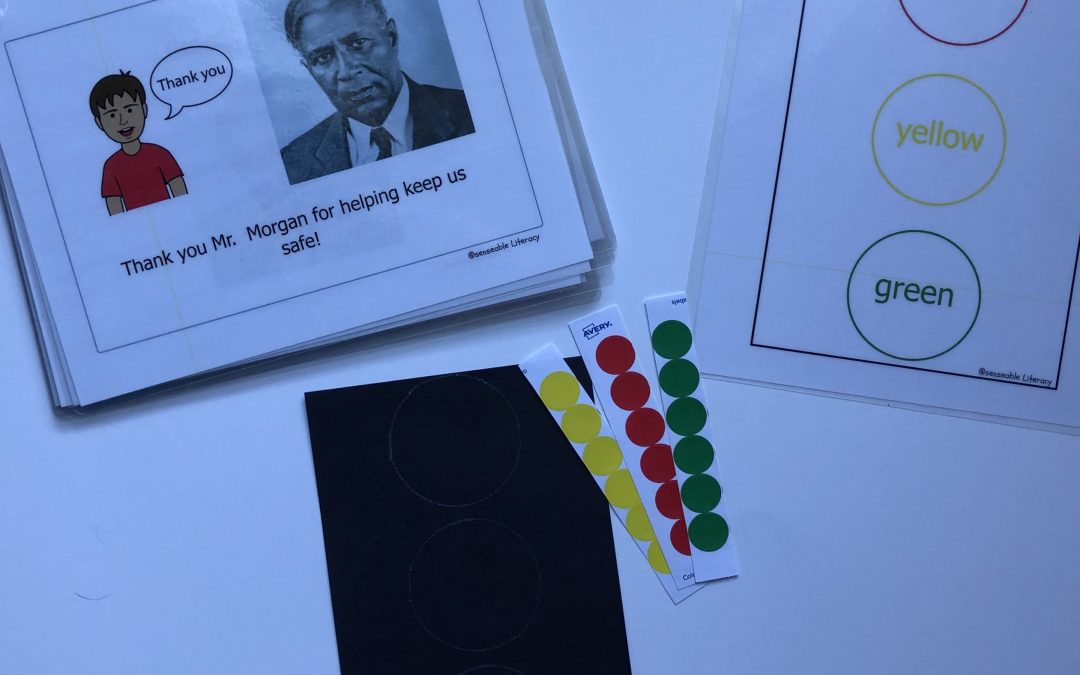
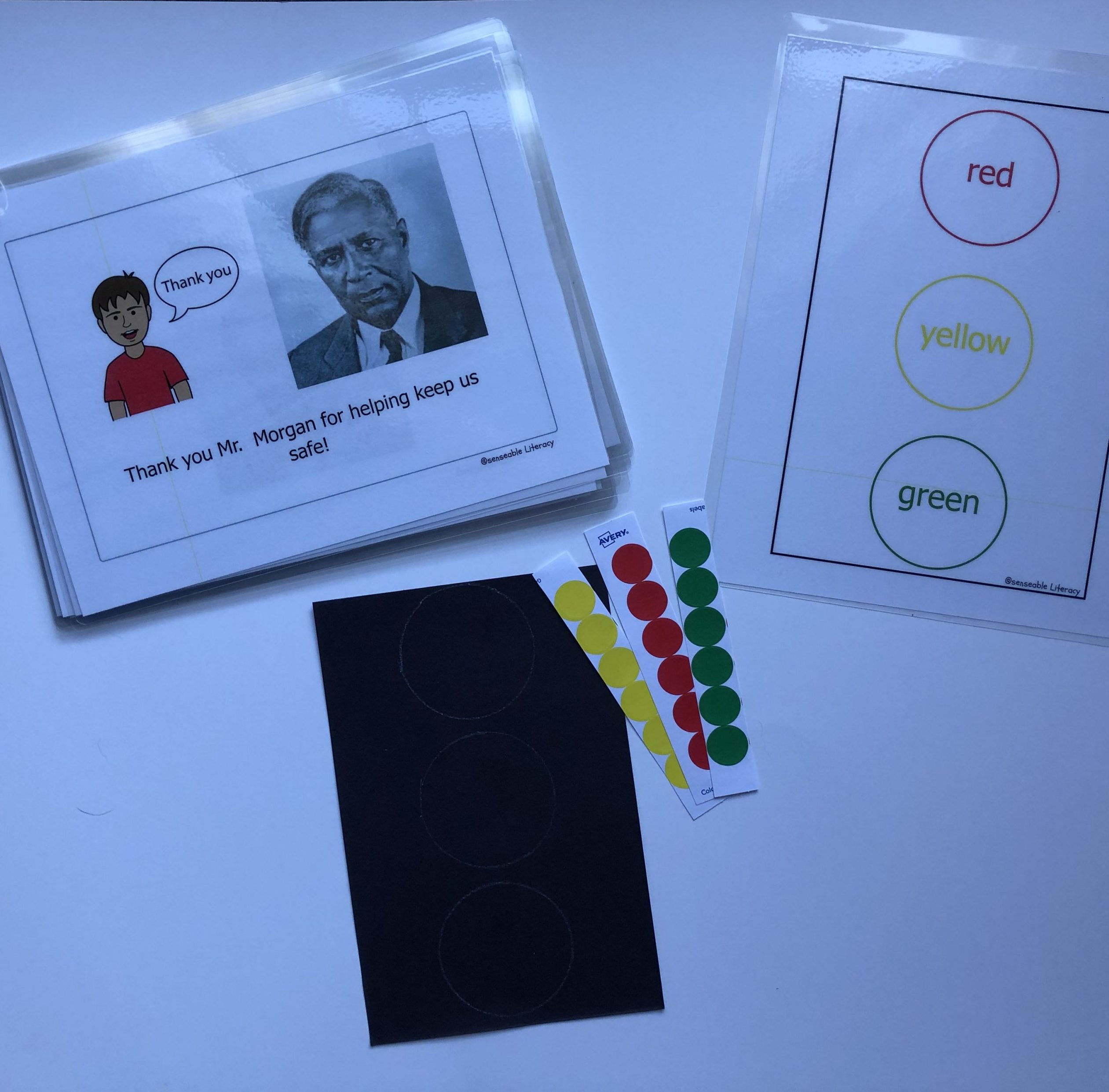
I chose to highlight Garrett Morgan, who added the yellow light to the stoplight as we now know it, within my lesson. With a quick Google search to find a picture of him, and learn a little more about him and his inventions, I took that information, opened Boardmaker 7 software and got to work! Using the printable book template, I was able to easily add in pictures, symbols and text that told the story of who Garrett Morgan was, why we need to learn about him, what his invention was (Mr. Morgan did invent items other than the stoplight, (i.e., the gas mask), but I thought this invention was most appropriate to highlight for my PreK students), and how it has affected our world. Here’s a sneak peek of the book:
Now What?
Now that I had the book, I needed to decide on the extension activities to continue our learning after we read the book. I chose activities that focused on color, shape and number recognition & labeling, spatial concepts, fine motor skills, bi-lateral (both sides) hand coordination, sorting, following directions, and gross motor skills.
Creating A Personalized Stoplight
In the first activity, the students create their own stoplight.
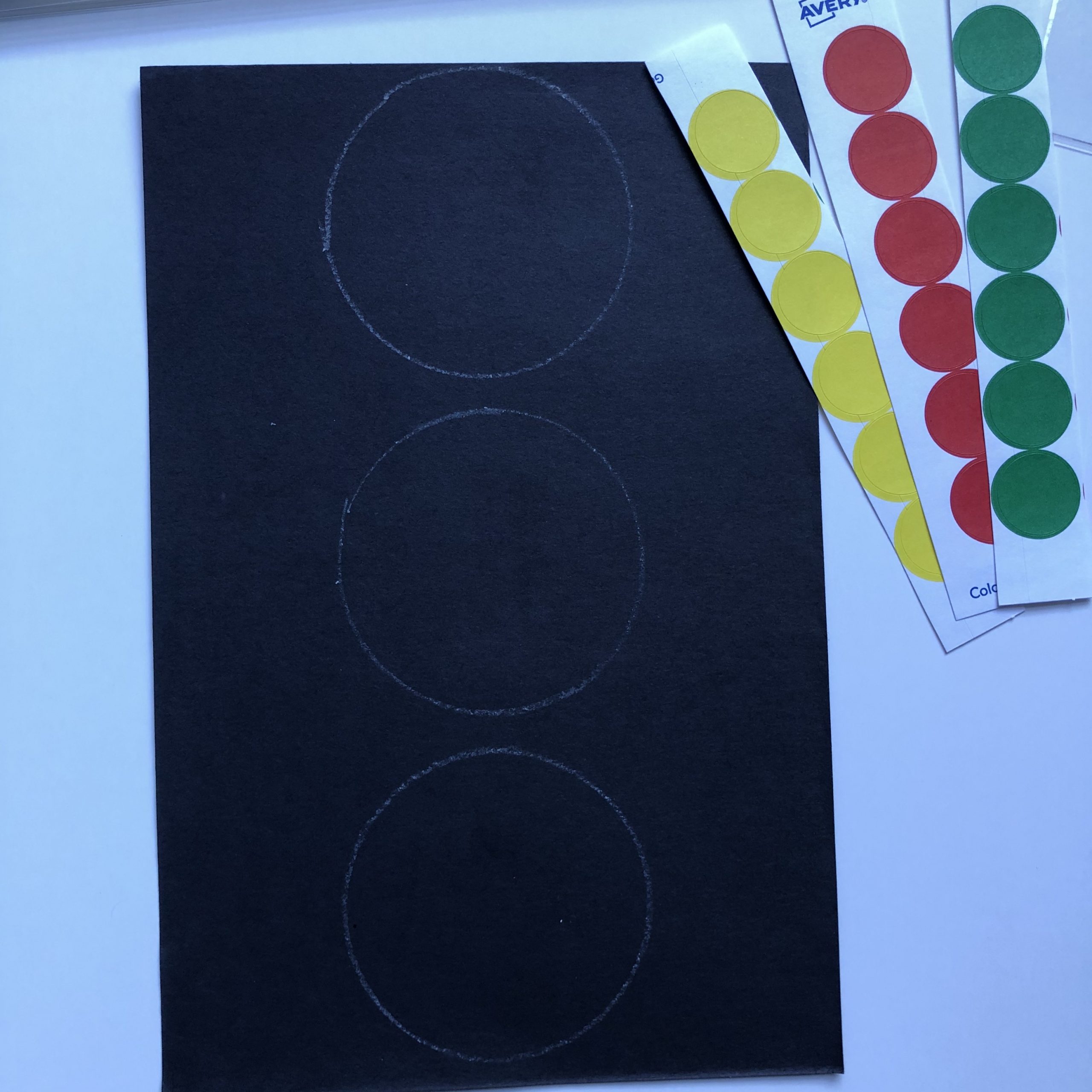
First, I cut black construction paper into rectangles and drew 3 circles down the center with a white crayon.
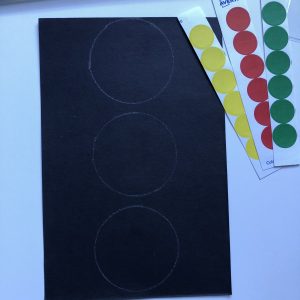
Stoplight template and stickers
Second, I cut color coding stickers from Avery into strips of yellow, green and red.
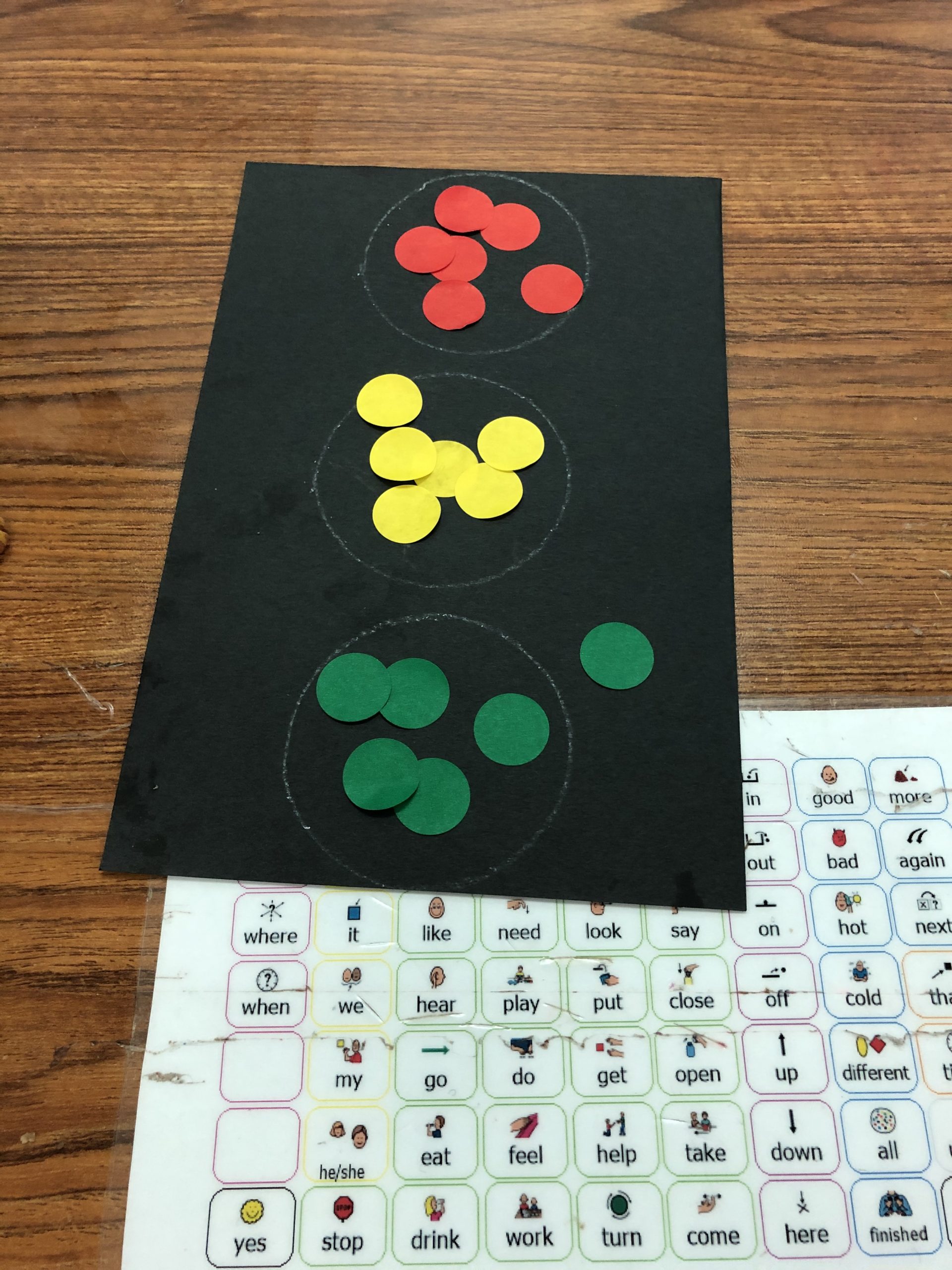
Each student was given a stoplight template and, after a model from an adult, placed all of the colored stickers onto their stoplight template. Hopefully the students placed the stickers in the right place based on color, but if not, that’s ok too – I am all about fostering independence and creativity and this is not a test!
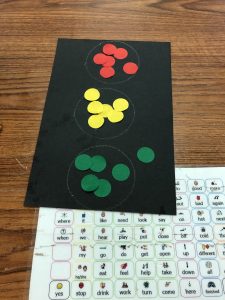
Student Created Stoplght
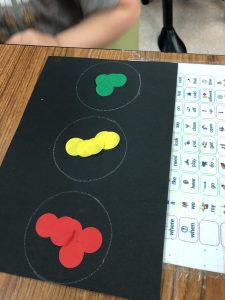
Student Created Stoplight
Additional Skills Addressed While Creating the Stoplights
While the students were making their stoplights, we were able to focus in on the topics of:
- Colors
- Shapes
- Location words (prepositions)
- Quantity (numbers, more, less)
Don’t forget all the Core Vocabulary!
And of course we used our core vocabulary communication boards to chat, modeling words, individually and in short phrases, such as:
- Put
- On
- More
- Where
- Help
- Want
- Like
- Not
- Different
- I
- My
- You
- Finished
- Here
- That
- Again
- Next
- See
- All
The Fun Doesn’t Stop There!
After students finish their stoplight you can:
- Help them write their name on their paper and send home to share with families.
- Laminate their stoplight to use in additional extension activities such as sorting by color.
- Use this sorting template to find items that are red, yellow and/or green in their environment.
- Watch some fun “stoplight videos” such as:
- Play “Red Light, Yellow Light, Green Light” to help get the wiggles out. You can use these visuals to further show students if they are to “GO”, “SLOW” or “STOP”.
- Play with cars and other vehicles, using your traffic light to tell the cars to “GO”, “SLOW down” or “STOP”
This Sounds Great! Where Can I Find These Resources?
If you are interested in doing these activities and/or reading the book about Garrett Morgan to your students I have linked them here for you to download:
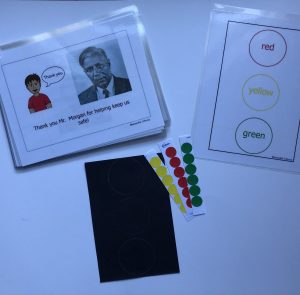
Garrett Morgan book and activities
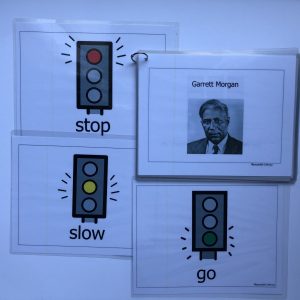
Garrett Morgan Printable and activities
If you create stoplights in celebration of Garrett Morgan and his invention, I’d love to see it!
Post pictures in the comments below or tag me (@senseableliteracy) in posts online!
Until next time – Happy Reading!
Recent Comments