by Megan | May 25, 2026 | AAC, aided language input, aided language stimulation, blog, book recommendations, books, continuing education, core vocabulary, emergent literacy, fringe vocabulary, modeling, Sensory, Sensory extension activities, tips, training
The “Story Time” Box
When I say “story time,” what comes to mind? Do you picture a teacher or librarian reading to learners who are sitting on a rug? Or maybe you think of bedtime, reading them a story before tucking them into bed. While these are both wonderful ways to picture “story time”, they aren’t and shouldn’t be the only images we think of. Shared reading or “story time” can happen anywhere and at any time.
Here’s the biggest reason we need to widen our literacy lens to include shared reading into our whole day. If we only open books during these specific, rigid windows, we limit our AAC users’ exposure to literacy and miss out on high-engagement moments throughout the rest of the day. The good news is that shared reading doesn’t require a designated “literacy block.” Today, we’re breaking down how to effortlessly weave literacy into the natural spaces of your entire day without adding more tasks to your to-do list.
Literacy in Transition Zones
While transitions might not be the first place you think of when looking for areas to add more literacy into your day, they are actually a perfect time.
- Why: Transitions (waiting for the bus, sitting in a waiting room, moving between activities) are often high-anxiety or high-boredom zones. Books provide a grounding focal point and a way to keep minds and hands busy.
- Actionable Ideas:
- Keep a “car book basket” for regular commutes or a book cart in transition areas of the home or classroom so learners can grab a book to read while they wait.
- Use short, high-interest digital books on a phone or tablet while waiting in lines, or bring a book bag filled with quick reads that you can easily share if the waiting is longer than expected.
- AAC Modeling focus: Go, Wait, Stop, Open, Look.
Environmental Print & Functional Reading
- Why: Literacy isn’t just found in the pages of a book. It’s all around us. Pointing out letters and words in the environment allows learners the opportunity to interact with them in multiple environments.
- Actionable Ideas:
- In the Kitchen: Read the steps of a recipe together while making a snack, or point out logos on cereal boxes, juice cartons, etc.
- Out and About: Point out stop signs, grocery store aisle markers, or giant billboards.
- AAC Modeling focus: Eat, Make, Big, See, Stop.
Play-Based Reading (Bringing Books to the Toys)
- Why: Meeting the learner where they are already regulated and happy. By bringing the book to them, you take away the frustration that might come from moving away from a preferred activity to reading. By bringing a book directly to their preferred toys, you are utilizing the sensory anchors we discussed in week 5 to pair high-interest concepts with natural language.
- Actionable Ideas:
- Bringing a book about construction vehicles directly into the sandbox or rug where they are playing with toy trucks.
- Read one page that matches what the toys are doing, giving language to their play that matches the book.
- AAC Modeling focus: Words like Up, Down, Crash, More, Like.
The “Routine Planner” Reminder
In week six of this shared reading series we talked about shared reading at home and shared a “home routine planner” highlighting a variety of ways that you can add books into specific routines to integrate literacy throughout the day. While you may be able to incorporate some of these into your classroom or therapy session, others may be only for routines at home.
However, using this mindset that you can incorporate literacy into all parts of your day, think about the different routines and activities that are staples in your classroom or therapy sessions. What books could you incorporate into that routine? Could you add in an extension activity to further the learning even more? This repetition with variety freebie may help you get your creative juices flowing.
Building beyond story time
If you’re feeling motivated and ready to start embedding literacy throughout the day but feel like you could still use some more guidance, my my e-book, Shared Reading with AAC users, gives tangible examples and ideas on starting and implementing shared reading throughout your day. And, because embedding literacy throughout the day is much easier when you don’t have to spend hours prepping the materials, I’ve got some ready to go sensory based literacy kits available in my shop that will make planning and prepping a breeze.
Before you go, share in the comments: What is one routine in your day where you could easily slip in a 2-minute story?
by Megan | May 11, 2026 | AAC, aided language input, aided language stimulation, blog, book recommendations, books, continuing education, core vocabulary, emergent literacy, fringe vocabulary, modeling, Sensory, Sensory extension activities, tips, training
We Finished the Book… Now What?
Stop!
Don’t put the book away yet!
You have finished your shared reading activity, but that is just the beginning! The connection that is created during shared reading can be used as a springboard for follow-up activities that turn a single story into a week-long learning experience.
Follow-up activities help deepen the connections between the reader and the story while promoting generalization of core vocabulary and bringing other themes, concepts, etc., to life. In this post, we will discuss five simple, no-prep activities that focus on engagement over “work” and show you how the learning doesn’t “stop” once the book is finished.
Activity 1: Predictable Chart Writing
Predictable chart writing is a collaborative writing activity where each learner completes the same sentence frame based on a concept or idea from the book that was read during shared reading (e.g., “On Monday, I ate _____”). The repetitiveness of this structure allows for consistent and repeated modeling of core and fringe vocabulary, lets the learner see their spoken words turned into text, and provides practice for emergent writing.
The full concept of predictable chart writing includes additional steps and teaching strategies focused on building print knowledge and sentence-building skills, etc., and you can dive even deeper into it here: https://project-core.com/professional-development-modules/.
While there are multiple steps to completing the full predictable chart writing process, you can start simple, writing your sentence frame on a whiteboard, poster paper, construction paper, or even a digital tablet. The focus should be on deepening the connection between the reader and the story and building their literacy skills through emergent writing and expression.
Activity 2: The “Story Retell” Sensory Bin
In the post “How Sensory Supports Can Make Shared Reading More Accessible and Engaging,” we talked about creating “literacy kits” or “story bins” to keep learners engaged during shared reading and build connections between the learner and the story. Providing learners access to these story bins after shared reading, during a center or open-ended play time, is a great way to encourage them to retell the story in their own way and deepen their connections to the story.
While observing their open-ended play and interactions with these literacy kits, we have additional opportunities to model core and fringe vocabulary that matches what they are doing in play, as well as reference back to the story and what they might be retelling through their play. If you need some reminders on what to model during these activities, this post might be helpful.
Activity 3: Text-to-Self Connections (The Photo Hunt)
Building connections between the text within a story and the lives of readers is a very powerful way to help readers engage with stories and see that the things they read about are all around them. One fun way to do this is to go on a photo scavenger hunt, looking for things that they read about in the story.
For example, if they read about a “big” dog, go on a scavenger hunt for other “big” things, and snap a picture of one when you find it. This brings what could be abstract concepts back to concrete thinking and shows how these concepts appear within the readers’ real lives. A bonus activity could be compiling all the pictures into a book to add to their bookshelves to revisit at a later date.
Activity 4: Digital “Book Trailers” or Recaps
One of my favorite things about being a reader is telling other people about my favorite books and why they should read them. Why not give that same experience to your learners?
There are many ways that you can do this using apps such as Pictello, Canva, Google Slides, or just your camera roll, taking pictures of the learners’ favorite parts of the book and pairing those pictures with the learner sharing about that part of the book in their own words.
This activity builds narrative skills and gives the learners a “product” they can show off to others through their AAC device. (Bonus points if you embed the video into a button on their device for them to show others!)
Activity 5: Character “Check-ins”
Social-emotional learning and teaching descriptive vocabulary lend themselves to acting and experiencing. Often, characters are described by what they look like, what they are doing, or what they are feeling. While illustrations can sometimes show these descriptions and emotions clearly, other times they are more difficult to determine from illustrations alone.
This is where the character “check-ins” can be really helpful, not to mention fun! Learners can act out the emotions that the character is feeling. If the character is “mad”, everyone can make their “mad” face and find “mad” on their AAC system. If they are being “silly”, everyone can show what they think “silly” looks like and find that word on their AAC system as well.
Not only does acting these things out help deepen the connection between the characters and the readers, but it also teaches them how to locate and use these important words in calm and engaging environments so that they will learn to use them in environments when they are feeling “mad” or “silly” themselves.
Which one will you try first?
After reading through these different ideas, I hope that you see how much more learning and fun can be done once you reach the last page of the story. Remember that shared reading is just the beginning of the lesson, and the connection that you create during that routine can be deepened and continued long after you close the book.
If you are looking for some “ready-to-go” literacy kits with interactive extension activities prepped and ready to go without any extra work on your end, check out my sensory-based literacy kits available as full kits with the book included, kits with just the materials, and digital downloads.
Before you go, share in the comments which activity you are excited to try first with your learner(s) as a way to extend and deepen your connection to the story!
by Megan | Apr 13, 2026 | AAC, aided language input, aided language stimulation, blog, book recommendations, books, continuing education, core vocabulary, emergent literacy, fringe vocabulary, modeling, Sensory, tips, training, Uncategorized
The “Perfect Book” Trap
If you’ve ever found yourself looking at a bookshelf filled to the brim, feeling overwhelmed and wondering “Is this one right for shared reading with my AAC user?”, you are not alone.
Since “AAC friendly” isn’t a category that books are organized into, at the library or bookstore, we need to shift our way of thinking when browsing. Choosing a book isn’t about it being “AAC friendly”, it’s about it being engaging, interesting and fun for both you and the AAC user.
My goal for this post is to simplify the process of choosing a book to read with your AAC user and reassure you that there is no “perfect book”. Once you realize that, you can spend less time searching for books and more time reading them. Here are the three pillars I use to find books that naturally invite communication.
1. High Predictability
One of the first things I look for is how much predictability is built into the story. Predictability reduces the “work” a learner has to do to follow the story, which leaves more room in their brain to think about what they want to communicate.
This predictability usually looks like repetitive lines or a rhyme and rhythm that creates a natural pause for the AAC user to chime in. Think of classics like:
- “But the bear snores on…”
- “But he was still hungry.”
- “There was an old lady…”
- “Chicka Chicka Boom Boom”
Pro Tip: If you find a book you love that isn’t predictable, you can make it predictable. Simply choose a repeated comment, request, protest or sound effect to say on every single page. Suddenly, any book becomes accessible!
2. Core Word Capacity (Moving Beyond Nouns)
A common mistake is picking books just for labeling (like “dog,” “cat,” or “truck”). While nouns are great, Core Words (verbs and descriptors) are the words that give a learner power across their whole day.
I look for “Action-Heavy” or “Emotion-Heavy” books. For example:
- Go/Stop: Great for any book about transportation or animals moving.
- In/On/Under: Perfect for lift-the-flap books or “hide and seek” stories.
- Like/Don’t Like: Excellent for stories about picky eaters or characters with strong opinions.
Modeling “go” or “scared” gives your learner a word they can use in a hundred other situations outside of this specific book.
3. Visual Clarity & Sensory Considerations
Finally, consider the visual and sensory “load” of the book. This is highly personalized. Some readers may prefer real photographs, while others find very busy, detailed illustrations distracting.
The Sensory Anchor: If a book has different textures or interactive elements, it is almost always a “sure thing” for me. These elements act as an “
My “Three-Question” Quick Filter
Next time you are at the library or bookstore, use these three questions to find your next great read:
- Does it have a repeating phrase (or can I create one)?
- Can I model at least 3 core words easily and repeatedly?
- Is the topic actually interesting to the learner? (This is the most important rule!)
DOWNLOAD THE QUICK-FILTER CHEAT SHEET HERE
Start browsing confidently!
You are ready to start checking out books with confidence, knowing that engagement matters far more than “perfection.”
If you want to dive even deeper into the “how-to” of shared reading, my e-book, Shared Reading with AAC Users: A Neurodiversity-Affirming Guide, walks you through everything from setup to tracking progress.
One more thing before you go… share in the comments: What is the one book your learner requests over and over?
by Megan | Jun 11, 2023 | AAC, blog, training
Let me tell you about one of my favorite AAC tools. It’s wonderful to have in your back pocket for assessments, goal writing, progress monitoring, and more – and best of all, it’s FREE!
I could go on and on about my love for this tool, but for now, let me introduce you to the Dynamic AAC Goals Grid – 3 (DAGG-3). Here’s a quick overview of what the DAGG-3 gives us:
- Provides a way to systematically assess/reassess current AAC skills
- Assists with the development of a comprehensive plan for increasing communicative independence for the AAC user.
- Ensures that all communicative competencies are considered in an evaluation.
- Shows patterns of strengths and weaknesses to help determine the next steps for intervention.
- Acknowledges progress toward independence.
- Presents a “big picture” view of every learner and helps develop communication goals for now and the future.
That’s a lot of goodness right there! Let’s break it down step by step and section by section. (It will be helpful if you are able to download the materials from the link above or at least have them open in another tab while reading through this information to get the clearest picture of each section and its use.)
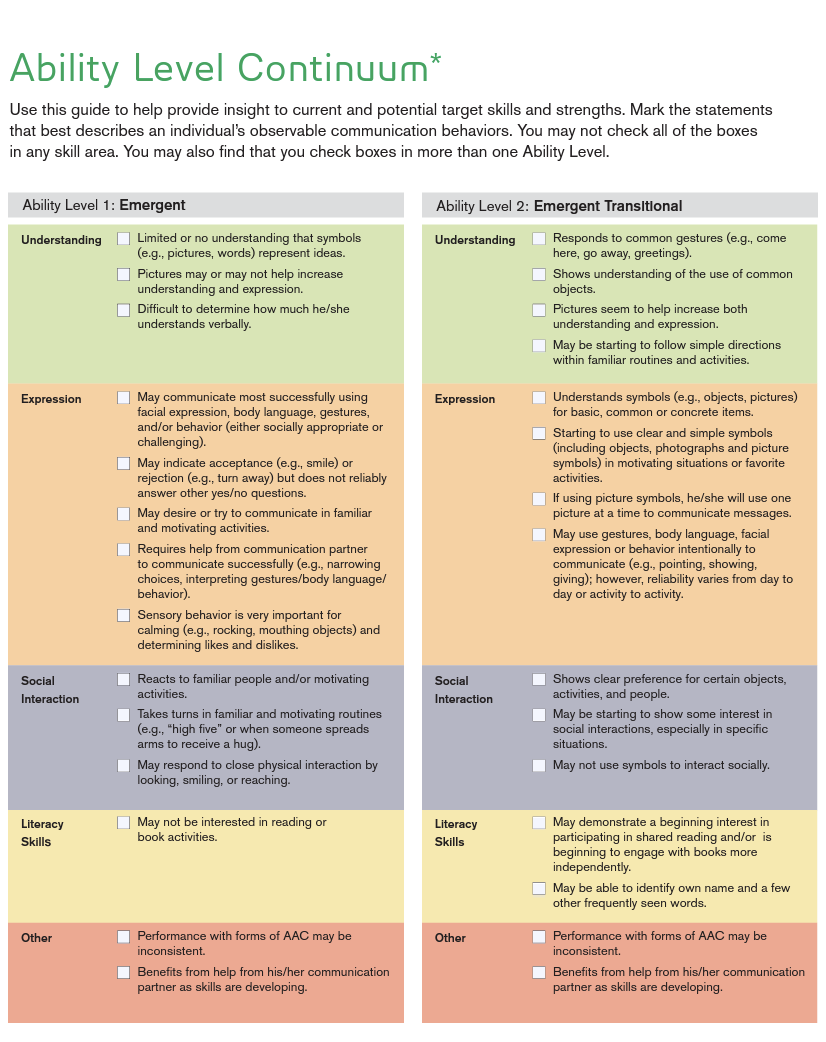
Let’s start with how to use the DAGG-3 for initial AAC assessments. We start with the “Ability Level Continuum” guide. This guide is broken into five different levels: emergent, emergent transitional, context-dependent, transitional dependent, and independent. Each of these levels are further segmented into specific areas: understanding, expression, social interaction, literacy skills, and other.
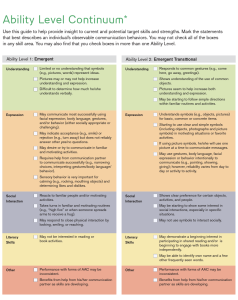
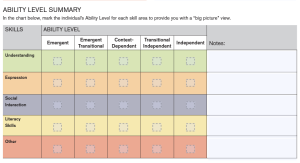
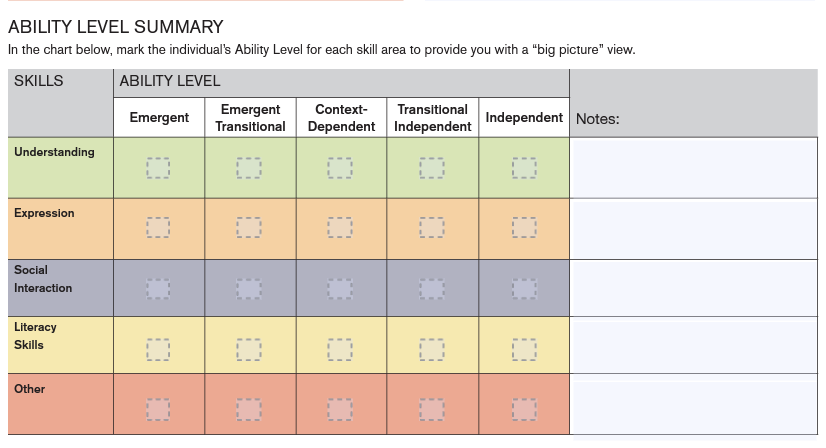
This guide is completed based on the learner’s current AAC use, keeping in mind that a learner may be at different levels for each of the different areas. Information gathered from completing this guide gives insight into the learner’s current skills and strengths in each area. After completing the guide, you can summarize the findings and see an overview of how independent they are within each area. There is also a section where you can make notes of various communication characteristics you observed, other communication modalities they use, strengths, barriers, etc. Once this guide is completed, you move on to the next step – choosing goals to address in one or more areas.
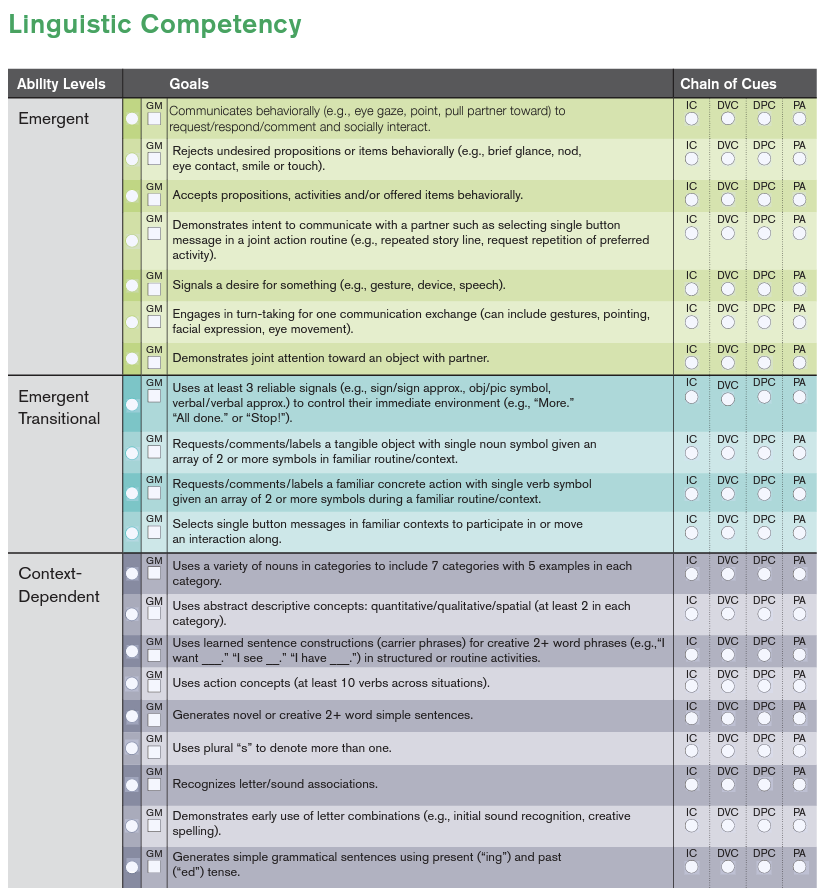
Referencing the information gathered & summarized in the “Ability Level Continuum” guide, we use that information to choose potential goals for the learner, within each of the different communicative competencies. Sample goal ideas are provided both for each communicative competency (linguistic, operational, social, & strategic) and for different levels outlined in the “Ability Level Continuum” guide. A chain of cues prompting hierarchy is also provided for each goal and level so that you can indicate which level of cueing the learner currently needs.
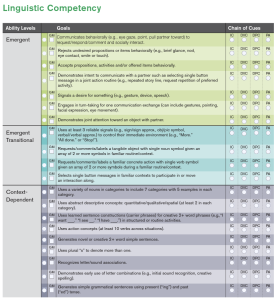
Using the ability levels and chain of cues provides an opportunity to not only see where your learner is currently with their AAC use and their independence, but it also allows you to see the next steps to continue progression and independence within each competency.
Now that we know where our learner is in their AAC use journey in reference to each of the communicative competencies, how independent they are within each of these skills, and have looked at some possible goal ideas, it’s finally time to draft the goals and objectives!
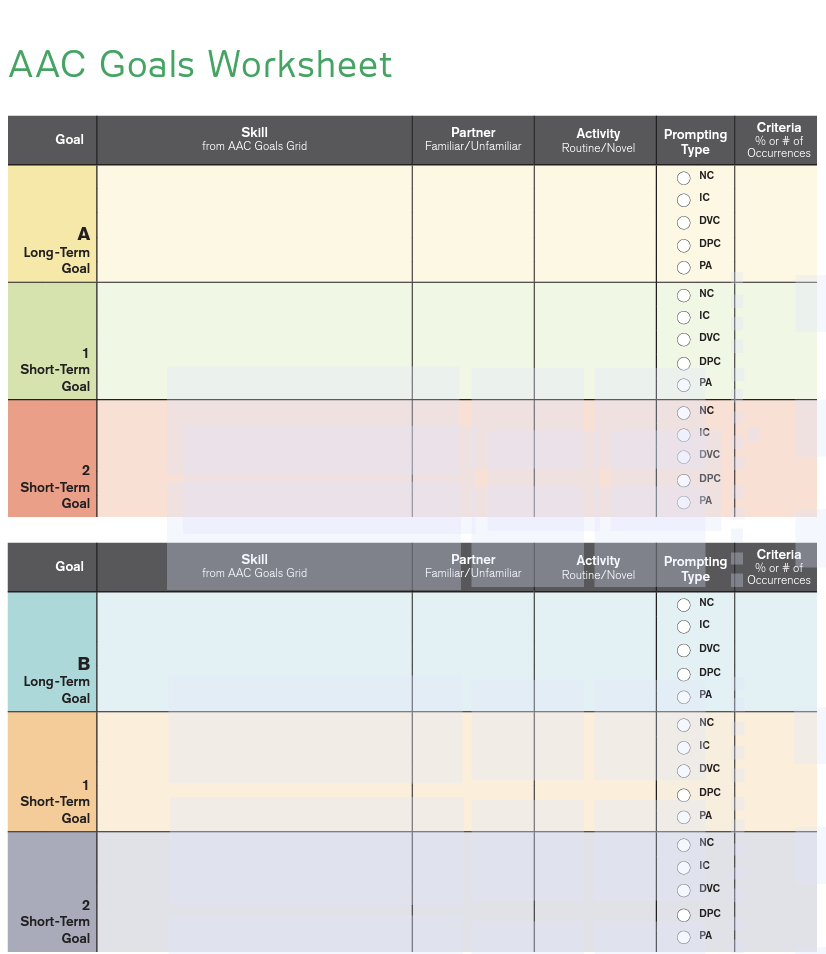
Once again the DAGG-3 is here to help with worksheets that walk us through the goal writing process step by step. AAC Goal Worksheets are here to help us choose a skill from each of the communicative competencies that we selected within the AAC Goals Grid, adding in the communication partner(s), activity, prompting type, and criteria to complete the goal.
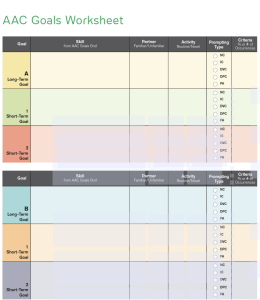
Talk about an all-in-one tool! Just using this one tool you have completed the AAC assessment, determined strengths and areas that need additional support, and written goals and objectives that will drive your treatment sessions! But, the goodness of the DAGG-3 doesn’t stop there! You can also use this tool for reassessments and progress monitoring – read on to find out how.
There are three different ways to look at reassessment & progress monitoring using the DAGG-3:
- Look back at the Dynamic AAC Goals listed by competency and mark any progress in the level of cueing. (Use a different color pen and/or mark the date of reassessment to denote progress monitoring.)
- Use the AAC Goals Periodic Progress Report to record progress in each competency area. Keeping track of the percentage of goals mastered within each competency area will help you track and see when a learner is ready to move towards a different independence level within each competency level.
- Using this information, review the goals you wrote using the AAC Goals Worksheet and revise as needed.
If you are still unsure on how to use the DAGG-3 there is a detailed instruction PDF that walks you through exactly how to use the tool included within the free resources.
By now I am sure that you are in love with the DAGG-3, just as much as I am but I have a surprise for you – there’s still more goodness to share!
- Not only is the DAGG-3 available in paper form, but it is also available digitally, still FREE, through the Pathways for Core First app. Within the digital version of the DAGG-3, you can create “users” for multiple learners, as well as print, save, email, and update individual information as needed. This digital version is a great way to reduce paperwork AND each goal within the goals grid has lesson plans and activity ideas that you can download to help you work with your learners towards achieving their goals! You can access the digital version of the DAGG-3 in the Pathways for Core First app here.
- Paired with the instructions is a sample report written with information gathered from the DAGG-3 to help you get started writing a comprehensive evaluation or progress report.
- Within the resources there are a TON of different sample activities and goals that are ready for use and aligned with each ability level and competency area, FREE and ready for you to download. (Here’s a tip, if you scroll down to the bottom of each competency area there is a link for you to download all the goals/activities at once so you don’t have to click on each one individually.)
All the steps involved in AAC assessments, selecting goals, progress monitoring, etc can be very daunting and time-consuming. Hopefully, this information and the DAGG-3, either paper or digital versions, will help you feel more confident in your ability to complete these tasks effectively and efficiently!
Recent Comments